
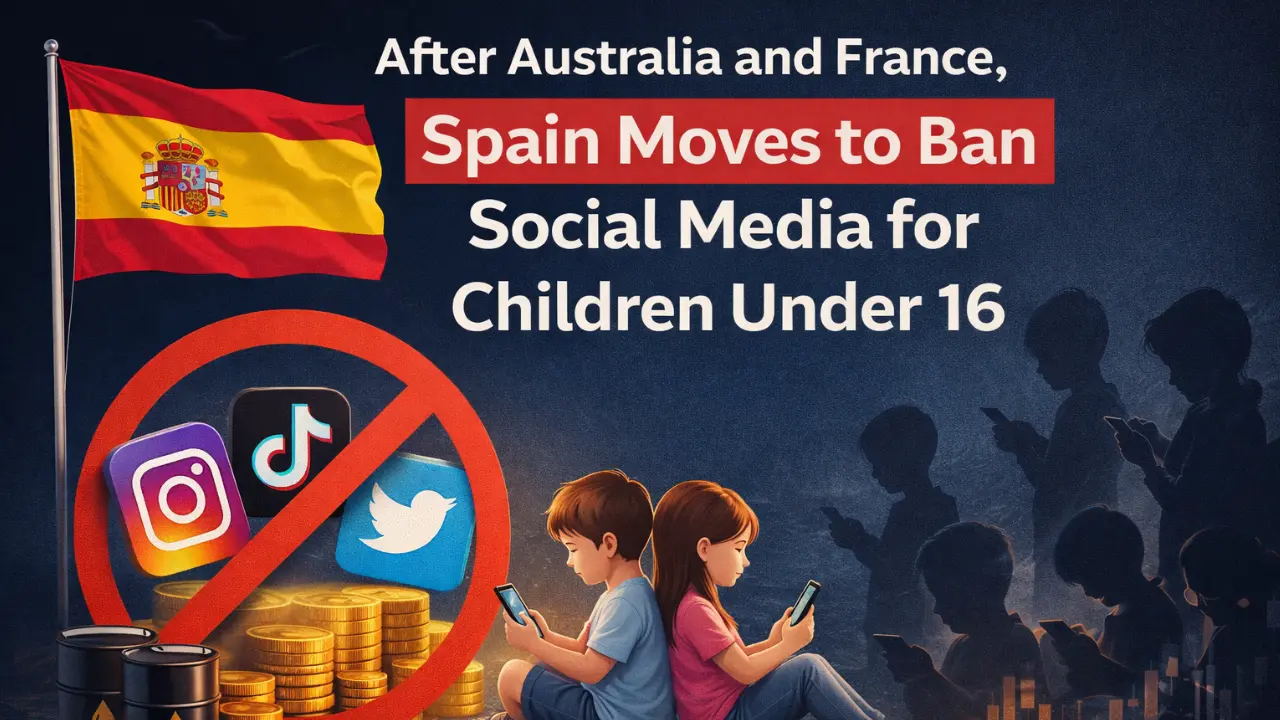
Spain is preparing to take a major step to protect children online. Prime Minister Pedro Sánchez has announced plans to ban social media access for children under the age of 16, citing growing concerns over harmful content, online abuse, and the unchecked power of tech platforms.
The move places Spain alongside countries like Australia and France, which have already introduced or approved similar restrictions for minors.
Speaking at an international summit in Dubai, Sánchez sharply criticized major social media companies for failing to control illegal and harmful content on their platforms. He pointed to the spread of child sexual abuse material and non-consensual sexualized deepfake images, saying governments can no longer afford to ignore the issue.
“Today, our children are exposed to a digital space they were never meant to navigate alone,” Sánchez said. “We will no longer accept that.”
According to the Spanish government, the proposed ban is aimed at reducing digital addiction, protecting mental health, and preventing minors from being exposed to dangerous online material.
Spain is not acting in isolation. Several countries are tightening rules around children’s access to social media:
Australia has already begun enforcing the world’s first nationwide ban on social media for users under 16. Platforms like TikTok, Instagram, Facebook, Snapchat, Reddit, and X can face penalties if they fail to prevent underage accounts.
France approved a law in January that bans social media for children under 15. The restriction is expected to take effect from the next school year, along with limits on mobile phone use in schools.
Other European countries, including Denmark and the UK, are also considering tougher regulations to reduce excessive screen time and online harm.
Spain plans to go beyond symbolic rules. The government wants social media companies to implement real and effective age-verification systems, not just simple checkboxes where users declare their age.
Officials have made it clear that platforms will be required to create actual barriers that work, ensuring minors cannot easily bypass age limits.
Currently, most social media apps set the minimum age at 13, but enforcement is weak and largely relies on self-reported information.
The proposal will be added to an existing bill focused on digital protections for minors, which is currently being debated in Spain’s parliament. While Sánchez’s government does not hold a clear majority, early signs suggest there may be cross-party support for stricter child safety rules.
Some opposition voices have questioned the government’s intentions, while others say similar proposals were already under discussion last year.
Beyond restricting access for minors, Spain is also planning stricter accountability for social media platforms. Proposed measures include:
Making it a criminal offense to manipulate algorithms to amplify illegal content
Holding tech executives responsible if criminal material is not removed
Treating technology companies as active participants, not neutral platforms
“No more pretending that technology is neutral,” Sánchez said.
Spain has also joined several European countries in forming what Sánchez called a “coalition of the digitally willing”, aimed at coordinating social media regulation at a multinational level.
As concerns grow over children’s mental health, online safety, and the influence of big tech, Spain’s move reflects a broader global shift toward stronger digital regulation.
With Australia, France, and now Spain taking firm action, the debate around children and social media is entering a new phase. Governments are increasingly stepping in where self-regulation by tech companies has failed — signaling that the digital space for minors may soon look very different.
No comments yet. Be the first to comment!